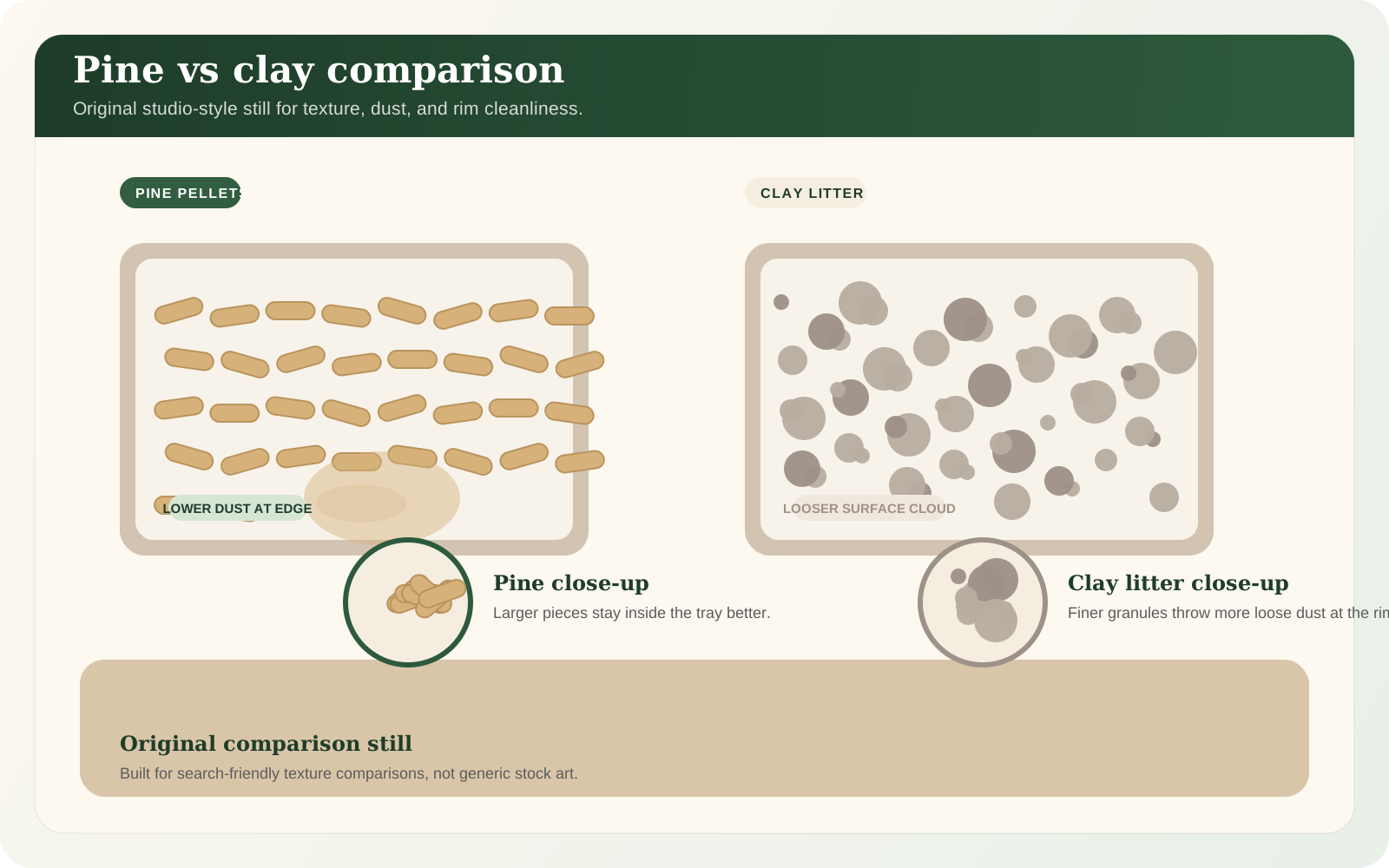
Original Visual
Pine pellets and clay litter side-by-side comparison illustration
Side-by-side illustration showing pellet size, surface dust, and the cleaner edge profile of pine.
This page is the category map for the site. Use it when you are still deciding between pine, clay, silica, tofu, and other litter families rather than choosing one specific brand. If you want the numbers behind the claims, start with the format comparison.
This page names everyone who worked on it and cites its external sources. We run no laboratory and test no litter ourselves. The scope below shows what was checked before publication.
Comparison coverage includes commercial products in the same category. The scoring language is separated from affiliate placement.
Five formats are scored in our format assessment. Use those rows for direct category evidence, not generic marketing claims.
Some litter families matter to readers before we have scored them. These stay on this page as editorial context until they have a published score row.
Start with categories here, check the scored formats in the comparison guide, then use the review library for product pages with illustrations and product-specific notes.
We rate pine ahead of clay on dust (8.8-8.2/10 vs 5/10) and tracking (8.6-9.2/10 vs 4/10), while silica leads on dust (9.1/10) and tofu sits closest to clay on transition difficulty (3.9/10 vs clay at 2.1/10).
An honest look at how different litter types perform across key metrics. Pine does not win every use case, clay still sets the familiarity and clumping baseline, and low-dust formats like silica can outperform wood on specific variables. The quick table below sticks to published our values for pine, clay, and silica; tofu appears in the breakdown cards and the full matrix on the Pine Litter Comparison. If tofu is the main alternative on your list, start with our focused pine vs tofu litter guide. If you need product-level takes after this, continue to the review library.
Pine, clay, silica, and tofu formats in the comparison guide have published score rows and scorecards. Those scores are our read of published specifications and owner reports. We measure nothing ourselves.
The quick-look table and category summaries compress those findings into broader category tendencies. They are directional, not raw dataset rows.
Corn, wheat, and paper are included so readers can map the full aisle, but they are not scored entries in our format assessment.
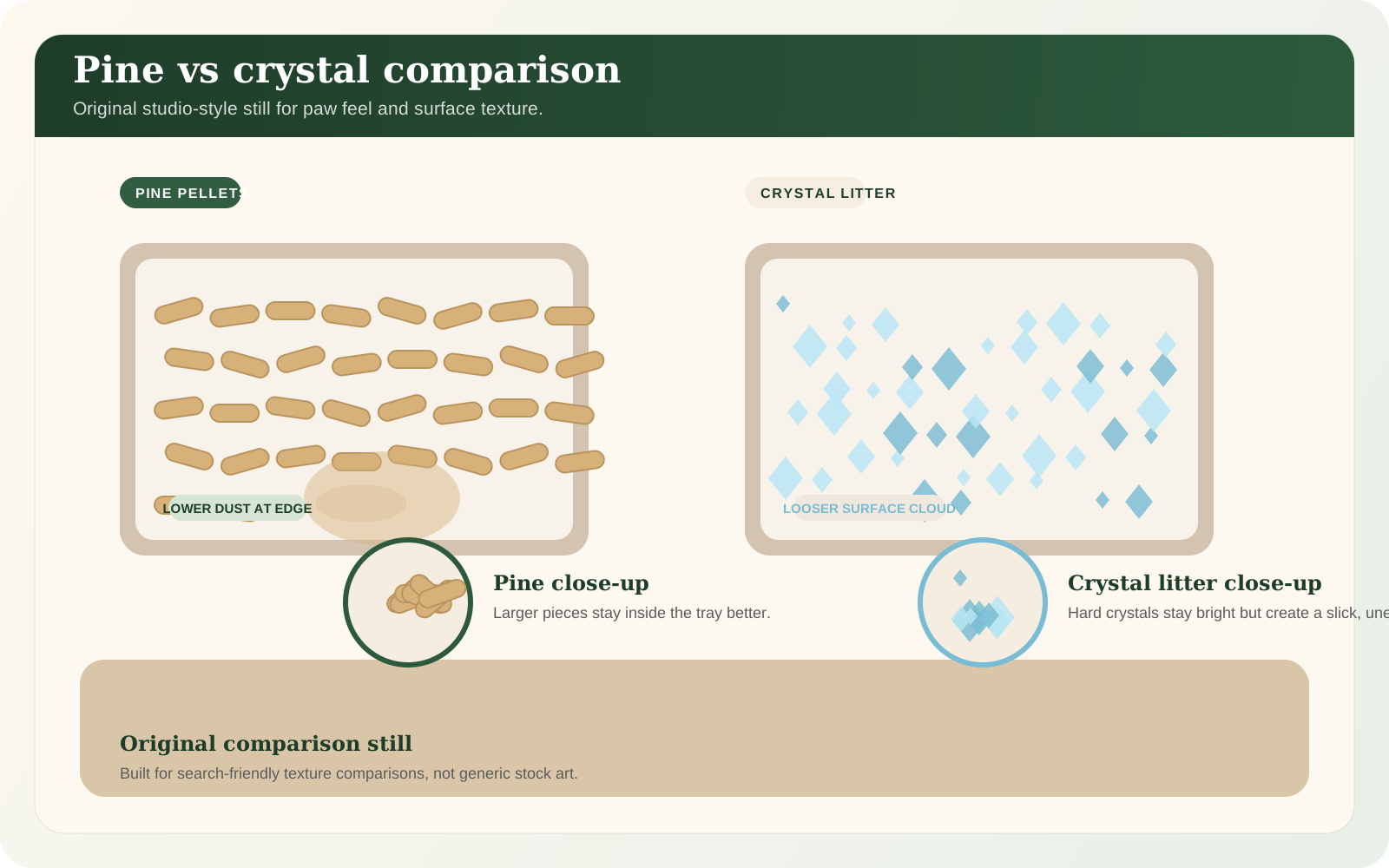
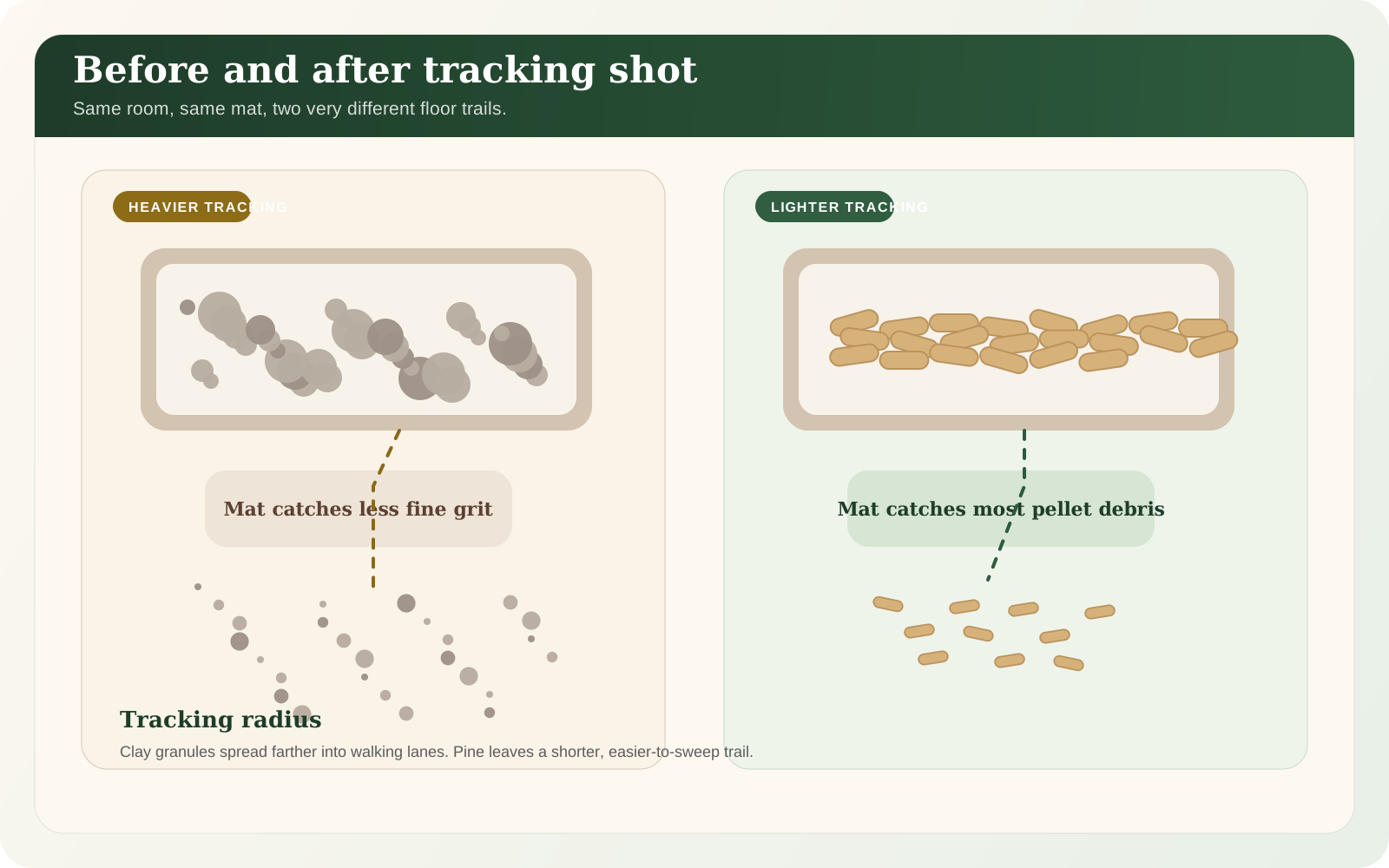
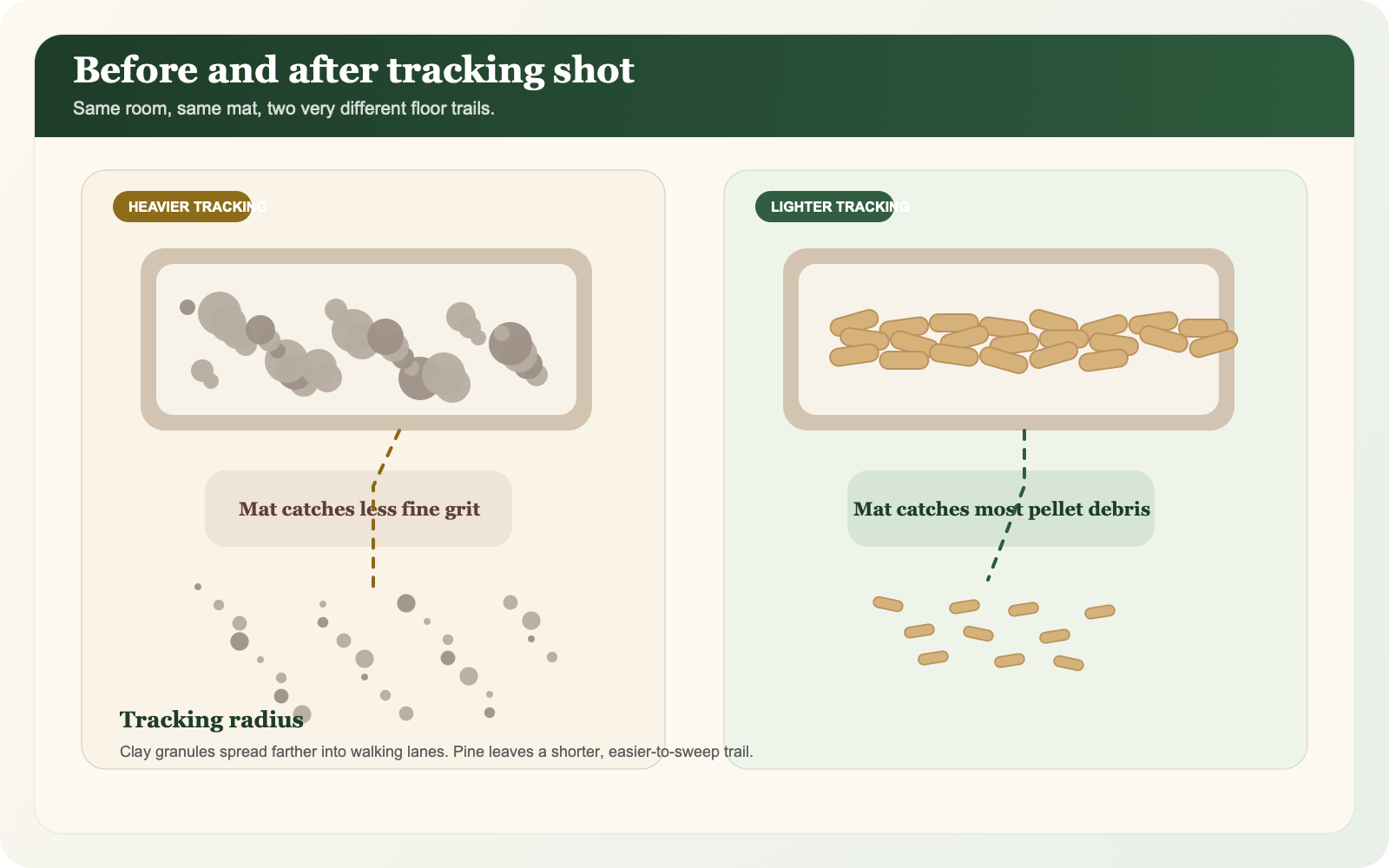
Illustrations drawn for this comparison page so texture, tracking, and surface behavior are visible in search and on-page. They are drawings, not photographs.
 Play demo
A closer look at each litter type's strengths, weaknesses, and cleanup style. Only pine, clay, silica, and tofu appear in our format assessment; the other plant-based formats below stay here as editorial category context.
In our assessment, pine scores above the clay control on odor control, dust, floor scatter, sifting, and carry weight, but it asks more of cats during the transition than either clay or tofu.
In our assessment, clay carries the lowest transition-difficulty score in the set, which makes it the familiarity baseline. The same set gives it the weakest dust score and the widest tracking spread.
Silica earns the highest dust score of the formats we cover, but it also carries the weakest sifting score and the highest monthly cost in the set.
In our assessment, tofu sits closer to clay on transition difficulty than either pine entry, while still cutting carry weight and improving dust performance relative to the clay control.
Included here only as category context for shoppers cross-checking plant-based clumping formats. Corn is not a scored entry in our assessment.
Another context-only plant category. Wheat is included because readers often cross-shop it against corn and tofu, not because this site has scored it.
Paper stays on this page as a recovery-oriented category reference only. It is not a scored entry in our format assessment.
Health, behavior, and safety claims are checked against veterinary, academic, or standards-based sources. See our editorial policy for more information on our sourcing standards.
Pine scores above clay on dust, tracking, odor control, carry weight, and sifting in our assessment. Clay still wins on transition ease and monthly cost. The better choice depends on whether dust and tracking or routine familiarity matters more to you.
In our assessment, silica crystals scored 9.1/10 on dust, followed by pine at 8.2-8.8/10, tofu at 7.5/10, and clay at 5.0/10. Pine and silica both produce meaningfully less airborne dust than standard clumping clay.
In our assessment, pine scores 8.4-9.0/10 on odor control, silica 7.5/10, tofu 6.8/10, and clay 5.5/10. Pine carries the strongest odor score in the set.
Comparison pages perform best when they send readers to adjacent, intent-specific explainers instead of dead-ending at a CTA.
Use the direct head-to-head when the real question is whether pine is worth leaving clay for.
Explore Topic →Use the focused comparison when plant-based tofu is the real alternative under consideration.
Explore Topic →Use the focused comparison when silica crystals are the real alternative under consideration.
Explore Topic →Inspect the published format scores for odor control, dust, tracking, cost, and multi-cat durability.
Explore Topic →Move from category trade-offs to brand-level review pages with illustrations, scorecards, and use-case calls.
Explore Topic →Route the category decision into a setup, transition plan, and evidence trail matched to your household.
Explore Topic →Use the setup and switching guide once you have chosen a direction.
Explore Topic →Dig deeper into pine-specific benefits and disadvantages after the category view.
Explore Topic →Decode the buying language if you are narrowing down to a specific pine product.
Explore Topic →See which pine setup scored best when odor pressure and tracking matter most in small spaces.
Explore Topic →Find the maintenance cadence and format that holds odor under multi-cat traffic.
Explore Topic →Once you know which litter format fits your cleanup style, use the review library for product-level calls or the guide for transition and setup.